✦ Yes or No
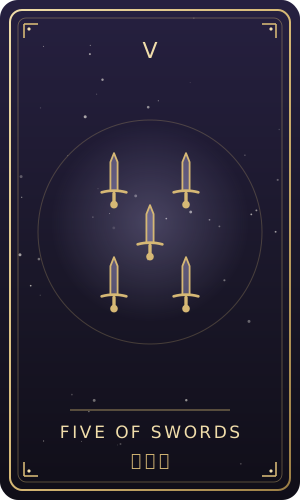
Five of Swords: Yes or No?
Upright
Leans no
Leans no: even if you can win on the surface, it may cost you trust or a relationship, so it's worth reconsidering before you push ahead.
Reversed
Depends
Leans maybe: the conflict is easing, and if both sides can let go of needing to win, things can still turn around.
Timing:A brief, tense period of conflict that usually resolves within days, though its echoes may linger.
Core meaning
Upright
In a dispute or competition, someone has won on the surface but lost trust and connection. Ask yourself whether this battle is truly worth fighting.
Reversed
After the conflict, a chance for reconciliation appears and you are ready to let go of winning; yet some resentment may still be smoldering and needs attention.
In key spread positions
- As the outcome
- Upright:The outcome may be a hollow victory: you might win on paper but lose something more valuable, so adjust your approach early.
- Reversed:The outcome points to reconciliation and letting go; you'll choose to stop fighting pointless battles and restore balance.
- As the obstacle
- Upright:The obstacle is an overemphasis on winning, or an environment full of rivalry and mistrust that makes cooperation difficult.
- Reversed:The obstacle is unresolved resentment: peace on the surface while the scorekeeping quietly continues underneath.
- As advice
- Upright:Ask yourself whether this battle is worth fighting. When needed, step back and save your energy for what truly matters.
- Reversed:Extend goodwill and talk things through, while honestly addressing your own hurt so you can truly let it go.
Advice:Before the next argument, ask yourself: do I want to win, or do I want to solve this? Choose the battles worth fighting and release the rest.
FAQ
What does the Five of Swords mean in love?
In love, the Five of Swords often points to arguments, power struggles or a standoff where neither person backs down. It reminds you that winning a fight can still damage trust. It isn't asking you to swallow your feelings; it's inviting you to consider what you both want to protect more than being right.
What does the Five of Swords reversed mean?
Reversed, it usually signals an opening for reconciliation after conflict, as both sides become willing to let go of winning. It also reminds you that if resentment lingers, it's best to talk it through properly; otherwise the peace may only be temporary.
Does the Five of Swords mean I'm going to lose?
Not necessarily. This card is less about winning or losing and more about the cost of victory. It asks you to weigh whether a competition or argument is worth your energy. Sometimes walking away with your dignity and relationships intact is the wiser win.