The Scariest Tarot Cards and What They Really Mean
· 5 min read
Death, The Tower, The Devil: some tarot cards look terrifying. Here is what they really mean upright and reversed, why they speak of transformation and awareness rather than doom, and what to do when one appears.
Turn over a card and find a skeleton on horseback, a tower split by lightning or a horned devil, and your pulse will probably jump a little. These are the cards people call the "scariest" in tarot, and the ones beginners most often ask about with real worry. Tarot imagery is bold on purpose, though. The more dramatic the picture, the more important the thing it wants you to notice. Let's go through them one by one: what they actually mean, and how the upright and reversed readings differ.
Why Some Cards Look So Frightening
- Dramatic imagery. The Rider-Waite-Smith deck tells stories through strong symbols. Ten swords in a man's back is an exaggerated metaphor, not a literal forecast.
- Loaded names. Words like "death" and "devil" carry fear in everyday language.
- Movies and TV. Screen stories love using these cards to build suspense.
- Mood comes first. When you draw while anxious, almost any card can look like bad news.
Keep one thing in mind: there are no "bad" cards in tarot, only more challenging messages. Upright and reversed cards also speak in different tones, which our guide to upright and reversed meanings explains.
Death: An Ending That Makes Room
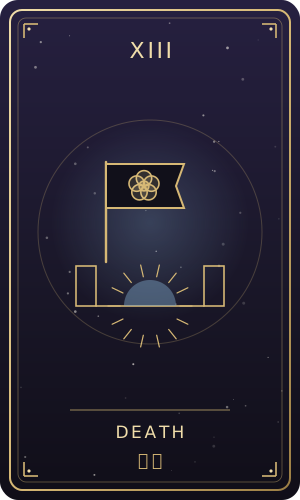
On the Death card, a skeleton in black armor rides a white horse, carrying a black banner marked with a white rose, while the sun rises between two distant towers.
- Upright: a chapter is closing naturally, making room for something new. This is transformation rather than loss, and it almost never refers to literal death.
- Reversed: part of you knows something has ended, yet you're still holding on. Resisting change only drags the transition out.
- Ask yourself: what has served its purpose and can be released with gratitude?
Curious how it reads in relationships? See Death in love readings.
The Tower: What Falls Was No Longer True
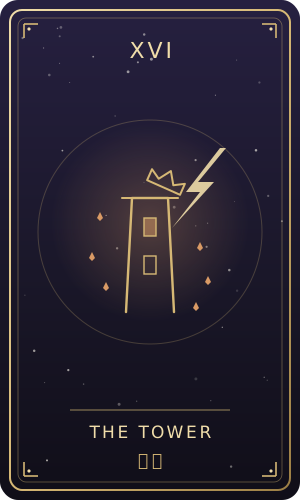
On The Tower, lightning strikes a tower on a rocky peak, knocking off its golden crown as two figures fall.
- Upright: a structure that seemed solid suddenly gives way. It's unsettling, but what it clears away was built on illusion, leaving room to rebuild on firmer ground.
- Reversed: you may sense change coming and be working hard to keep things as they are, or the upheaval may be happening inside you. Adjusting willingly can make the shift gentler.
- What helps: steady your breathing and routines first, take care of the present, then rebuild from what's real.
In the Major Arcana sequence, The Star comes right after The Tower. Read The Tower and The Star to see how they speak together, or Death and The Tower if both appear in one reading.
The Devil: Seeing the Chain Is How You Lift It
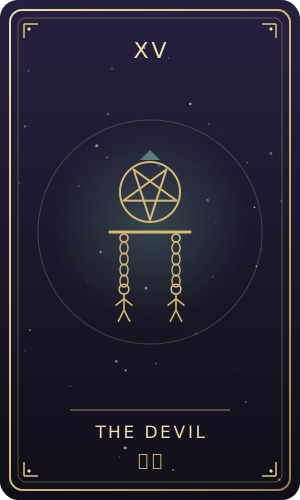
On The Devil, a man and a woman stand chained before the Devil's pedestal. Look closely, though: the chains around their necks are loose enough to lift off. That detail is the card's real message.
- Upright: you may feel held by a habit, relationship, desire or fear that seems beyond your control. Seeing the chain clearly is the first step to choosing freely again.
- Reversed: you're starting to recognize the pattern that keeps you stuck and getting ready to break free, while still facing any attachments you haven't released.
- Ask yourself: what need is this habit or relationship really trying to meet?
In love, The Devil often points to intense attraction mixed with possessiveness or heavy dependency. At work, it can describe being tied to a draining job by salary, title or the need for security. It isn't blaming you; it's asking you to see the real cost so you can choose freely.
Ten of Swords: Rock Bottom, and the Edge of Dawn
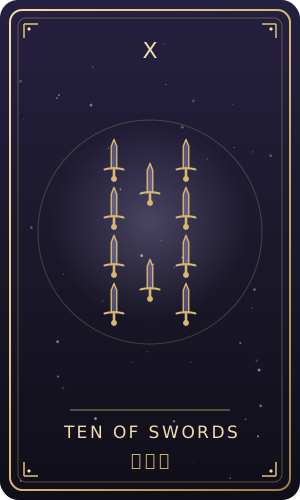
The Ten of Swords may be the most shocking image in the deck: a figure lies face down by the water with ten swords in his back. Yet a golden dawn is breaking on the horizon, and the water has gone calm.
- Upright: a chapter has reached its end, and the hardest part is happening now or has just passed. Accepting the ending is what makes room for the next beginning.
- Reversed: you're slowly getting back on your feet, though refusing to let go can stretch the pain out longer than it needs to be.
- A reminder: rest and grieve. Once the lowest point has passed, the only way left is up.
The Moon: Unease in the Fog
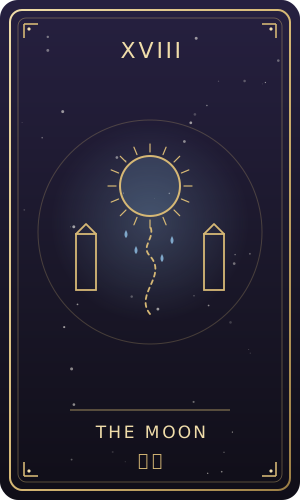
The Moon hangs between two towers while a dog and a wolf howl at it, a crayfish crawls out of a pool, and a winding path leads toward distant hills.
- Upright: things aren't clear yet, and emotion and imagination may be magnifying your unease. Listen to your intuition, but don't mistake guesses for facts.
- Reversed: the fog is lifting, and buried feelings or truths are surfacing. It's a time to regain clarity.
- What helps: slow down, verify the facts patiently, and don't let imagined fears make decisions for you before you can see the whole picture.
Death, The Tower and Ten of Swords: How They Differ
All three deal with endings, and they're easy to confuse, but their rhythms are very different:
- Death is like a change of seasons: a natural, gradual ending where the work is letting go.
- The Tower is like a lightning strike: a sudden collapse caused by outside events or a hard truth, where the work is rebuilding.
- Ten of Swords is a painful situation reaching its lowest point, where the work is admitting it's over, then resting and recovering.
Knowing which kind of ending you're facing helps you see whether to release, rebuild or simply take care of yourself first.
Nine and Three of Swords: The Heartache Cards
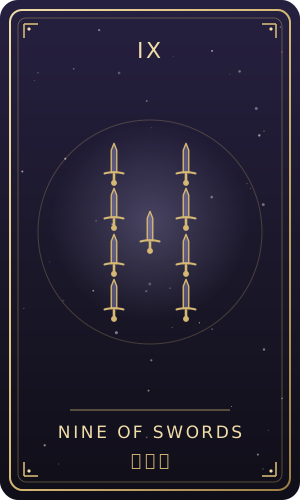
- Nine of Swords: someone sits up in bed at night with their face in their hands, nine swords on the wall behind them. The swords never touch the sleeper; the torment lives in the mind. Upright, it's anxiety and imagining the worst; reversed, the anxiety is easing, or the worry has been pushed even deeper. Try writing down the thoughts keeping you awake and sorting facts from fears.
- Three of Swords: a heart pierced by three swords, the image of heartache and loss. Upright, it invites you to grieve; reversed, healing has begun, though it also asks you not to pretend you're fine.
If you've been struggling with sleep or low mood for a while, please don't rely on the cards alone. Talk to someone you trust, or reach out for professional support.
What to Do When a Scary Card Shows Up
- Look for the hope in the image. The sunrise behind Death, the dawn in the Ten of Swords and the Devil's loose chains are all right there in the picture.
- Return to your question. What is this card pointing to that needs to end, change or be seen?
- Check the position and the other cards. The same card means something different as an obstacle than as advice.
- Ask once. Don't keep redrawing to get a nicer card.
- Write down one small action. Turn the card's message into something you can do today.
For a lighter counterweight, read about the luckiest tarot cards, and for more reading myths, see tarot taboos and myths.
Practice With These Cards on ORAE
ORAE Tarot is completely free, with no sign-up needed, and interpretations follow fixed, transparent rules rather than AI. Every draw uses a cryptographically secure random shuffle with a published seed hash, so no card is ever placed in your path on purpose.
- To practice sitting with a single card: draw one card.
- To compare upright and reversed meanings across all 78 cards: the tarot cheat sheet.
- To see The Tower through a yes-or-no lens: The Tower yes or no.
Tarot is a tool for reflection and a bit of enjoyment. It doesn't pronounce your fate, and it can't guarantee any outcome. The next time one of these cards appears, think of it as an honest friend: blunt, perhaps, but speaking up so you can see clearly.
FAQ
Does the Death card mean someone will die?
No. The Death card almost never refers to literal death. It represents the end of a chapter and a transformation that makes room for something new. Reversed, it suggests resisting an ending that has already arrived.
Is The Tower the worst card in tarot?
There are no truly bad cards. The Tower signals sudden change and revelation. It can be unsettling, but it clears away what was no longer true so you can rebuild on firmer ground.
Is The Devil reversed good or bad?
The Devil reversed often points to awakening and breaking free: you're beginning to see the patterns that held you and reclaim your choices, while still facing attachments you haven't fully released.
Should I redraw if I get a scary card?
It's better not to. Redrawing until you like the result is really choosing your answer. Take in the card's message, write down one small step you can take, and ask again once something has changed.
Is the Ten of Swords the most negative card?
Its image is dramatic, but it means hitting bottom and the end of a cycle: the hardest part is passing. The dawn on the horizon is there to remind you that things can slowly rise from here.
Try a reading on ORAE
Free, no sign-up, no AI: fixed, transparent interpretation rules.