Why Do I Keep Drawing the Same Tarot Card?
· 5 min read
Pulled The Hermit for the third time this month? Here is an honest look at how often repeats really happen, plus a simple four-step way to turn a recurring card into a useful question.
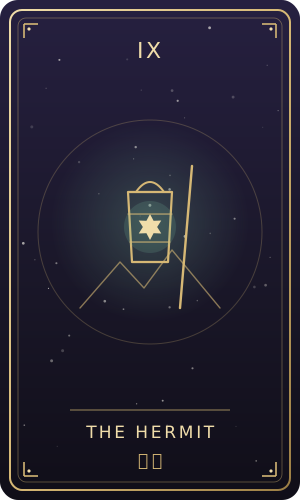
You pull The Hermit on Monday. Again on Thursday. Then it turns up a third time in a reading about something completely different. It's hard not to wonder whether the deck is trying to tell you something. This guide takes the question seriously from two angles: first the honest math of how often repeats happen, and then a practical way to work with a card that keeps showing up. The short version is that a recurring card isn't chasing you, but your reaction to it is worth paying attention to.
First, the Math: Repeats Are More Common Than You Think
With a fair shuffle of a 78-card deck, any particular card has a 1 in 78 chance of being drawn, roughly 1.3%. Add orientation and a specific card in a specific direction is 1 in 156. One draw at a time, that sounds rare. Over many draws, though, the picture changes completely:
| Scenario (fresh shuffle of all 78 cards each time) | Approximate chance |
|---|---|
| Your next card matches your last one | 1.3% |
| At least one repeat in 10 draws | 45% |
| At least one repeat in 14 draws (two weeks) | 71% |
| At least one repeat in 30 draws (a month) | 99.8% |
| Some card appears 3+ times in 30 draws | about 42% |
If you draw one card a day, a repeat within a month is close to certain. On average, 30 daily draws show you only about 25 different cards, and around four of them appear at least twice. It's the same logic as the famous birthday problem: give coincidence enough chances and it becomes ordinary.
Multi-card spreads speed this up. A three-card spread has about a 3.8% chance of including any particular card, and a ten-card Celtic Cross about 12.8%. Do a few larger spreads a week and familiar faces will turn up often.
With a physical deck there's also a practical cause. An incomplete shuffle can leave cards clumped together, and a worn edge can make one card slip out more often. Our guide on how to shuffle and cut tarot cards covers that.
Why Some Repeats Feel So Meaningful
If repeats are this common, why do some feel like a sign?
- We remember the dramatic ones. Draw The Tower twice and you'll never forget it. Draw the Four of Pentacles twice and you might not notice.
- Something is already on your mind. If you're stuck on a decision, the Two of Swords lands hard the first time and feels uncanny the second.
- Card meanings are broad. The Hermit's "step back and look inward" applies to nearly anyone with a busy life.
None of this makes a repeat meaningless. It just locates the meaning in the right place: in your conversation with the card, not in the card's persistence. For more on the psychology behind this, read Is Tarot Accurate?
A Four-Step Way to Work With a Recurring Card
When a card keeps appearing, treat it as an invitation and give it ten focused minutes:
- Record the facts. How many times has it appeared? When, for which questions, upright or reversed?
- Look for the common thread. Were the questions all about work? Did you draw late at night while anxious?
- Read the full meaning once. Open the card's page and copy down the one sentence that hits hardest.
- Choose one small action. If this card were a friend's advice, what's one thing you could do this week?
Then let the card rest. If it comes back later, use it as a check-in: did you take that step?
A Worked Example
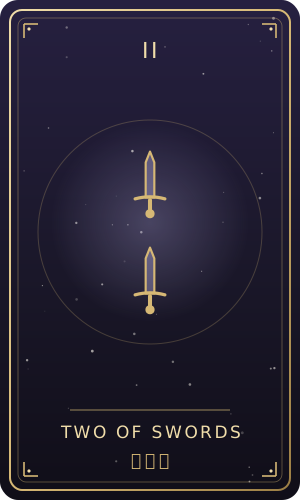
Say the Two of Swords has appeared three times in two weeks: once when you asked about switching teams at work, once as a daily card, and once when you asked whether to clear the air with a friend.
- Facts: upright all three times, twice drawn after work.
- Common thread: both situations hinge on what happens after you speak up, and you've been putting off both.
- The sentence that hit: "This calm is defensive, and sooner or later you will need to face what you already know."
- Small action: list three pros and three cons of switching teams, and invite your friend for coffee before Friday.
The useful insight isn't why the Two of Swords keeps coming back. It's that the card put two stalled decisions on the same page.
Common Recurring Cards and Questions to Ask Yourself
- The Hermit: Have I been so busy that I haven't made time to think things through?
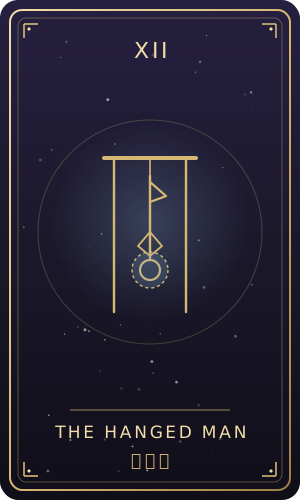
- The Hanged Man: What feels stuck, and what would it look like from a different angle?
- Two of Swords: Which choice am I avoiding, and what am I afraid will happen if I choose wrong?
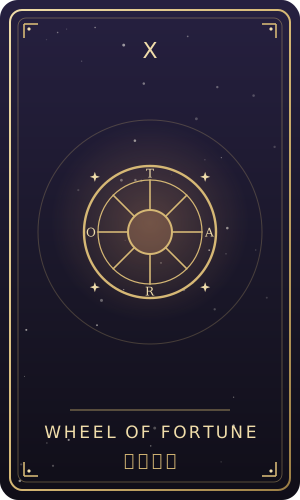
- Wheel of Fortune: Is there a pattern that keeps repeating in my life? What could I do differently this time?
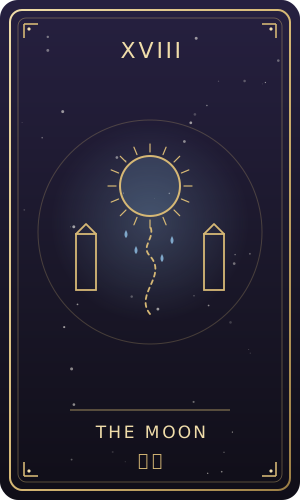
- The Moon: Which of my worries are facts, and which are stories I'm telling myself?
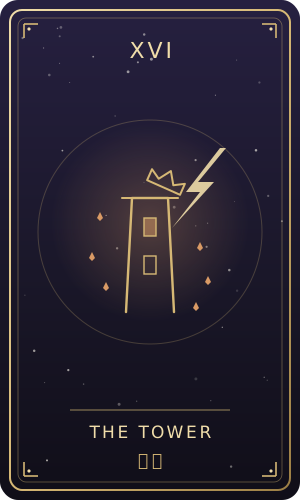
- The Tower: Is there a structure I've been propping up that's already cracking?
These questions have no right answers. The goal isn't to decode what the card "wants." It's to let it prompt a question you wouldn't normally ask yourself.
When It's a Type of Card, Not One Card
Sometimes what repeats isn't a single card but a family of cards. That's worth noticing too:
- Lots of Major Arcana: you may be working through a bigger life theme. Give it time rather than rushing to conclusions.
- One suit keeps showing up: Cups usually point to feelings and relationships, Pentacles to work, money and the body, Swords to thoughts and communication, and Wands to drive and action. Our lesson on the four suits is a quick refresher.
- The same number recurs: several Fives often reflect conflict, loss or disruption, while Eights tend to reflect effort and momentum.
The same caveat applies: with enough cards, these patterns are common. Read them as hints about where your attention has been lately.
When It Flips Between Upright and Reversed
If the same card keeps alternating orientation, read it as two sides of one theme. The Hanged Man upright is a meaningful pause; reversed, it's waiting that brings nothing new. Seeing both may be asking whether your current waiting period is actually giving you a fresh perspective. Our lesson on upright and reversed cards goes deeper.
When to Stop Drawing
If you notice yourself drawing again and again on the same question, scanning each result for the familiar card, the most useful move is usually to stop. Repeated draws on one question mostly produce different cards and more confusion. Wait until something in the situation has actually changed, then ask again.
Tracking Repeats on ORAE
Every ORAE draw uses a fresh, cryptographically secure shuffle with a published seed hash, so a repeat is pure chance: nothing is arranged, and being signed in or not makes no difference. Your daily reading keeps the same card all day, which makes it a steady baseline to observe. For a specific question, draw one card. If you create a free account, you can keep your reading history, favorites and a tarot journal with mood tags, which makes it easy to see which cards recur and how you were feeling each time. It pairs well with the 30-day daily one-card practice.
Tarot is a tool for reflection and entertainment. A card that keeps showing up isn't a warning from fate. It's more like a mirror, giving you a reason to pause and notice what's really been on your mind.
FAQ
Is the universe sending me a message if I keep drawing the same card?
Statistically, repeats are normal: with one draw a day, you will almost certainly see a repeat within a month. A repeat is not an omen, but if a card resonates, it makes a good starting point for reflection.
What are the odds of drawing the same tarot card twice in a row?
With a fresh shuffle of all 78 cards, the chance your next card matches the last is 1 in 78, about 1.3%. Matching orientation too makes it 1 in 156. Uncommon, but not extraordinary.
If I get the same card for the same question, is the answer certain?
No. It may be coincidence, or it may simply touch the part of the situation you care about most. Instead of treating it as a confirmed answer, write down what the card brings up and what you plan to do.
What should I do if I keep drawing difficult cards?
Stop redrawing and give yourself some time. Challenging cards usually point to something worth adjusting rather than predicting bad events. Reading what the scariest tarot cards really mean can help you see them more calmly.
What does it mean when a card jumps out of the deck while shuffling?
Some readers treat a jumper card as an extra hint, but it often comes down to shuffling technique or worn card edges. Shuffle thoroughly first; if the card still resonates, treat it as a theme to think about.
Try a reading on ORAE
Free, no sign-up, no AI: fixed, transparent interpretation rules.