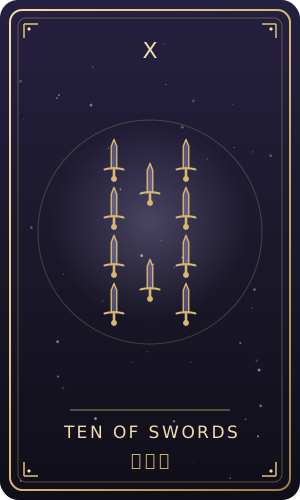
✦ Career
Ten of Swords in Career
Upright
A project, role or phase at work may be drawing to a close, leaving you discouraged or drained. This could be an opportunity to rethink your career direction. Rest first, then distill from this experience what you need for the next step.
Reversed
You are getting back on your feet after a professional setback, gradually regaining confidence and drive. It is a good time to update your résumé, learn new skills or map out a new direction. If you are still stuck in a role that no longer fits, honestly assess whether it is time to leave.
Job search & interviews
Upright
Your job search may have brought a run of setbacks that makes it feel like rock bottom. But the bottom also means the worst moment is already here, and every step from now leads up. Rest briefly, then go again.
Reversed
You're gradually recovering from a low and rebuilding your direction and confidence. New opportunities may arrive when you least expect them; keep moving, and don't let past failures define you.
At work
Upright
A chapter at work may be ending, such as a project wrapping up, a role changing, or your enthusiasm for the job running out. Accepting this ending helps you consider what you truly want next.
Reversed
The hardest stretch is behind you, and you're regaining your rhythm and confidence at work. The lessons you've learned along the way will become your most practical strength going forward.
Business & side projects
Upright
A project or partnership may be officially ending, and the loss needs time to process. But closing a direction that's no longer viable also frees resources to redirect toward something more promising.
Reversed
You're rising from a business low point. Progress may be slow, but each step is solid. After reviewing the past and adjusting strategy, a new beginning is already taking shape.
In key spread positions
- As the outcome
- Upright:The outcome points to a complete ending. It's painful, but the worst is already here, and a new beginning is quietly forming.
- Reversed:The outcome is a gradual recovery from rock bottom; you'll rise again and carry deeper insight into what comes next.
- As the obstacle
- Upright:The obstacle is difficulty accepting that something is over, or sinking so deeply into loss that you can't see the road ahead.
- Reversed:The obstacle is refusing to let go, returning to old wounds again and again so pain that should end keeps going.
- As advice
- Upright:Accept the ending. Let yourself rest and grieve, and lean on people you trust; this is the foundation for starting over.
- Reversed:Release the last of what you're holding onto and focus on repair and rebuilding; every small step forward deserves recognition.
Advice:Let this chapter end; you don't need to keep propping it up. Rest and grieve, and trust that dawn is already rising on the horizon.
FAQ
Is the Ten of Swords the worst card in tarot?
It's often seen as a difficult card because it represents an ending or rock bottom. Yet it carries an important message: the worst moment is already here, and from now on things gradually rise. It describes an emotional or situational low point, not a prediction of disaster.
What does the Ten of Swords reversed mean?
Reversed, it usually shows you slowly recovering from a low and wounds beginning to heal. It also reminds you that if you refuse to let go of the past, the pain may last longer than necessary. Acceptance, release and support from trusted people make recovery smoother.
Does the Ten of Swords mean a relationship is over?
In love, the Ten of Swords often marks an ending, which could be a relationship, a pattern, or an unrealistic expectation. It doesn't necessarily mean two people have no future, but it does say the old way can't continue. Either a new way of relating begins, or it's time to bravely let go.