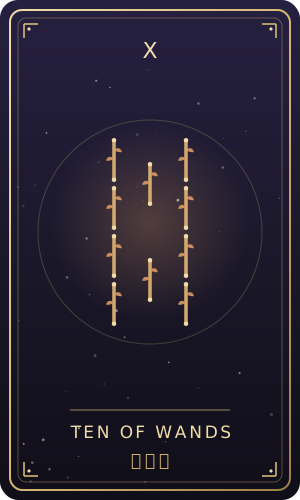
✦ Career
Ten of Wands in Career
Upright
Your workload has exceeded your capacity, perhaps through juggling several projects or taking on responsibilities that belong to others. The finish line may be near, but take stock of your tasks, set priorities and delegate where you reasonably can.
Reversed
This is the moment to learn to say no. Renegotiating your scope, handing tasks to the right people or dropping low-value projects can return you to a sustainable pace. If you are close to burnout, make your wellbeing the first priority.
Job search & interviews
Upright
You may be job hunting while still working, or juggling too many interviews and tests at once, and feeling stretched thin. Focus your energy on the few most important opportunities rather than applying everywhere.
Reversed
You have finally decided to leave a job that was crushing you, or you are rethinking what kind of career you really want. Give yourself time to reflect so your next role does not repeat the same pattern.
At work
Upright
Your workload is clearly overflowing, perhaps from taking on too many projects or cleaning up after others. The goal may be in sight, but recognise your limits, learn to delegate and be willing to say no.
Reversed
You are beginning to let go, handing some tasks to colleagues or renegotiating your responsibilities with your manager. Watch for signs that you are close to burnout; adjusting early is far better than holding on until you break.
Business & side projects
Upright
Growth has brought a flood of responsibilities, and you may be doing everything yourself and wearing every hat. It is time to build systems, find partners or outsource some work, or success itself may weigh you down.
Reversed
You have realised you cannot carry everything alone and are starting to streamline, delegate or close unprofitable lines. This is a turning point that lets your business move forward travelling lighter.
In key spread positions
- As the outcome
- Upright:The outcome is reaching the goal but at a high cost, leaving you drained and in need of a serious look at what you are carrying.
- Reversed:The outcome is learning to let go and share the load; something must be released, but in return you gain breathing room and a lighter life.
- As the obstacle
- Upright:The challenge is excessive responsibility and the habit of carrying everything alone, which blocks your view and leaves no energy to enjoy results.
- Reversed:The challenge is refusing to let go, or exhaustion after holding on too long, perhaps from fear that everything will collapse if you put anything down.
- As advice
- Upright:List every responsibility you hold, identify which truly belong to you, and practise delegating and saying no.
- Reversed:Have the courage to drop unnecessary burdens, allow yourself to rest and invite the people around you to share the weight.
Advice:List every responsibility you are carrying, mark what can be delegated, postponed or dropped, and hand off at least one item today.
FAQ
Does the Ten of Wands reversed mean I should let go?
Reversed, the Ten of Wands often shows a burden reaching its tipping point, and it does encourage letting go. However, what you release is not necessarily the whole relationship or job; it may be responsibilities that are not yours and expectations that are too high. Setting some weight down and asking for help often restores your strength.
What does the Ten of Wands mean in love?
In love, the Ten of Wands usually points to pressure and burden, perhaps one partner carrying too much or practical responsibilities weighing the relationship down. It does not mean love is absent. It asks you both to redistribute responsibilities and care for each other's fatigue, so the relationship stops feeling like another heavy load.
What kind of person does the Ten of Wands represent?
The Ten of Wands describes someone with a strong sense of duty who takes everything on themselves, from family needs and work to other people's expectations. They are reliable and hardworking but often overlook their own limits. If the card represents you, it is a reminder that carrying weight is admirable, and so is learning to put it down.