Should I Quit My Job? 5 Tarot Questions to Ask Before You Leave
· 4 min read
Dreading every Monday but scared to walk away? Here are five tarot questions worth asking before you quit, six cards that often show up when you want out, and how to compare staying versus leaving.
Maybe it starts with a knot in your stomach on Sunday evenings. Maybe it's watching a friend switch jobs and get a raise while you feel stuck. The urge to quit rarely appears overnight, and yet actually handing in your notice raises real worries about rent, savings and a gap on your resume. Tarot can't decide whether you should stay or go. What it can do is help you untangle the feelings before you decide. Below are five questions worth asking before you quit, the cards that often show up when you want out, and a practical way to compare two paths side by side.
First, Name What You Actually Want to Leave
"Should I quit?" is a big question that usually hides several smaller ones:
- The work itself: you're not growing, or the tasks feel meaningless.
- The people: a manager or coworkers who drain you every day.
- The terms: pay, benefits or commute no longer make sense.
- Your health: chronic overtime and poor sleep, with your body sounding the alarm.
- Your direction: your industry or your long-term goals have changed.
The more specific your question, the clearer the cards become. If the real problem is people, start with our guide to tarot for coworkers and bosses. If you're buried under workload, a team transfer or a frank talk about responsibilities might fix more than a resignation would.
Five Questions to Ask Tarot Before You Quit
- "What's really making me this exhausted?" One card aimed at the root cause often surprises people.
- "If I stay, what can I still learn here?" This keeps you from dismissing real value while your frustration is at its peak.
- "Am I afraid of change itself, or of this particular direction?" It helps separate "I don't want this" from "I don't dare."
- "What do I most need to prepare before leaving?" Savings, a portfolio, a certification, or an honest talk with family.
- "Option A: stay. Option B: take the new role. What does each path look like?" This turns a vague worry into choices you can actually compare.
These open questions tend to reveal far more than a simple yes-or-no "Should I quit?" For more on phrasing, see our lesson on how to ask tarot questions.
Six Cards That Often Appear When You Want Out
| Card | Upright may suggest | Reversed may suggest |
|---|---|---|
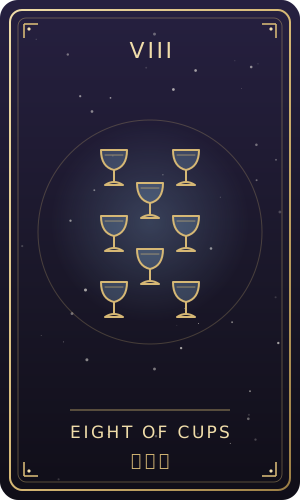
| Eight of Cups | A stable job that no longer feels meaningful | Wanting to leave without direction, or fear of losing security |
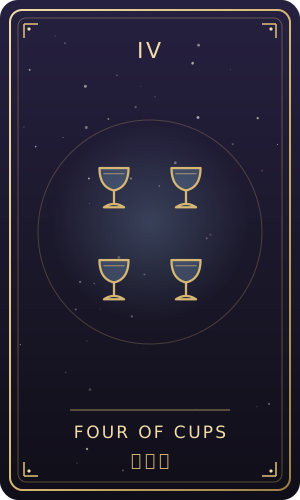
| Four of Cups | Burnout and apathy, possibly missing nearby opportunities | Motivation slowly returning |
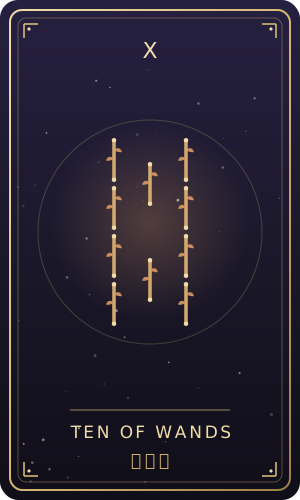
| Ten of Wands | Workload beyond capacity, carrying others' responsibilities | Learning to say no and renegotiate scope |
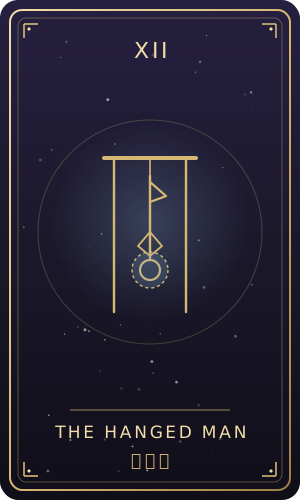
| The Hanged Man | A pause that invites a new perspective | Sacrifice that hasn't led to growth |
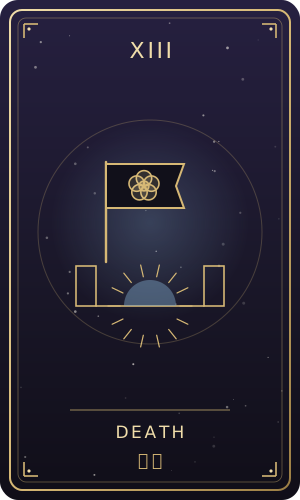
| Death | A chapter closing, clearing space for something new | Staying in a role you've outgrown, delaying needed change |
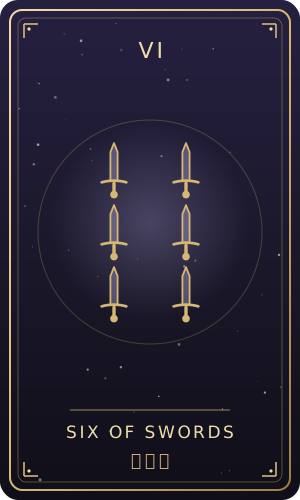
| Six of Swords | A steady transition toward a better fit | A new setting that repeats the same old problems |
A few nuances worth knowing:
- The Eight of Cups doesn't mean "quit tomorrow." It describes a heart that's no longer fulfilled, but leaving well takes courage and preparation. Paired with The Hermit, as in the Hermit and Eight of Cups combination, it's more of a nudge to get quiet and figure out what you're really searching for.
- The Four of Cups and Ten of Wands are often misread as "time to go." The first can simply be a burnout phase, and the second is about workload. Both can sometimes be improved with time off, a transfer or a clearer division of tasks.
- Death reversed isn't a bad omen. It suggests you don't need a dramatic move today, but you can start updating your resume and building skills so change happens at a pace you control.
Compare Both Paths with the A/B Choice Spread
The most practical approach is to rewrite "Should I quit?" as two concrete options and lay them side by side with the A/B Choice spread. For example: "A: stay and apply for an internal transfer" and "B: accept the new offer." When you read it:
- The path matters as much as the outcome. A pleasant outcome card next to a Ten of Wands path means a heavy load along the way. Ask yourself if you're willing to carry it.
- Pay close attention to the advice card. It often points to a lesson you'll meet whichever way you go.
- Put the practical facts on the table too. Salary, contract terms, probation period, commute and family needs all belong in the comparison.
If you don't have a clear Option B yet, try the six-card Career Development spread first to map your strengths, main challenge and potential opportunities.
A Hypothetical Example: Stay or Take the Offer?
Imagine you've spent three years in a marketing role and just received an offer from another company. You set the options as "A: stay and negotiate a lighter workload with my manager" and "B: accept the new offer," and you draw:
- Your situation: Ten of Wands. What's crushing you is mainly the workload, not necessarily the job itself.
- Path A: Four of Cups reversed. If responsibilities get clarified, your motivation could slowly return.
- Outcome of A: Eight of Pentacles. Staying lets you keep building solid, practical skills.
- Path B: Eight of Wands. The new place moves fast, with lots of change.
- Outcome of B: Seven of Cups. The offer looks tempting, but plenty of details are still fuzzy.
- Key advice: Queen of Swords. Be calm and direct, and ask the questions that matter.
This spread isn't saying "stay." It gives you a to-do list: talk to your current manager about workload, and ask the new company about real working hours, the actual scope of the role and probation terms. Once you have fuller information on both sides, the decision tends to feel much steadier.
Three Common Mistakes
- Drawing right after a rough meeting. Strong emotions magnify every difficult card. Wait at least until the next day.
- Resigning the moment you get a hopeful card. However encouraging the spread, first work out how many months of living costs your savings can cover and where you're heading next.
- Treating tarot as the only input. Leaving a job affects your income, your rights as an employee and often your family. Tarot is a tool for clearer thinking, not a guarantee of how things will turn out.
If your reasons for leaving involve unpaid wages, unpaid overtime or pressure to resign, talk to a labor rights office or employment advisor in your area first. In Taiwan, the Ministry of Labor's 1955 hotline offers free advice on these issues.
Try It on ORAE
The Job Change reading on ORAE opens with the A/B Choice spread by default. It's completely free and you don't need an account. Every draw uses a cryptographically secure shuffle, and interpretations follow fixed, transparent rules rather than AI, with Basic, Deep and Expert levels of detail. If what you're really considering is a side project rather than a full career switch, read Is a side hustle right for me?. Already lining up interviews? See Will I get the job? Interview tarot.
FAQ
Can tarot tell me whether to quit my job?
Tarot cannot make the decision for you. It works more like a mirror, helping you see why you are exhausted, which conditions matter to you and what each path might feel like. Weigh your finances and career plans alongside any reading.
Does drawing the Eight of Cups mean I should definitely quit?
Not necessarily. The Eight of Cups shows that your current situation no longer fulfills you and you are ready to look for something more meaningful, but it also implies preparation. An internal move, a course or a planned transition can come first.
What should I ask tarot before quitting without another job lined up?
Ask "What do I most need to prepare before leaving?" rather than "Should I quit now?" Then calculate how many months your savings can cover and list what you need from your next role.
How soon can I ask about changing jobs again?
If nothing has changed, avoid asking the same question again right away. A new reading makes more sense once you have new information, such as interview feedback, a final offer or a conversation with your manager.
I drew Death in a career reading. Is something bad going to happen at work?
No. In a career context Death usually marks the end of a chapter, such as a project wrapping up, a role changing or a career shift, which clears space for what comes next. Reversed, it warns against delaying a change you already need.
Try a reading on ORAE
Free, no sign-up, no AI: fixed, transparent interpretation rules.