Tarot for Coworkers, Bosses and Office Politics
· 4 min read
Is it the work that wears you out, or the people? Learn how tarot can describe bosses and coworkers, which cards point to smooth teamwork or office politics, and how to respond in practice.
Plenty of people would say the work itself isn't what wears them down; it's the people. A manager who changes direction every week, a coworker who takes credit, group chats that go silent, gossip that spreads faster than official announcements. In Taiwan, people sometimes blame this on a "xiaoren" (小人), a folk term for someone who quietly undermines you behind your back. Tarot can't identify who that person is, and it shouldn't be used to cast suspicion on everyone around you. What it can do is help you see the patterns in your working relationships and how you might respond. This guide covers how to ask, which cards often represent bosses and coworkers, which ones call for caution, and what matters more than any reading.
Rephrase the Question: Skip "Who's Against Me?"
Questions like "Who's talking about me behind my back?" tend to make you view everyone with suspicion, and the cards rarely give a reliable answer. Shift the focus to what you can actually influence and the reading becomes far more useful:
- "Where is the biggest gap between my manager and me?"
- "How can I respond to this coworker more effectively?"
- "How is my role on the team being seen right now?"
- "Where is my discomfort at work really coming from?"
- "What's one step I can take to improve this working relationship?"
Using Court Cards to Read Bosses and Coworkers
In relationship readings, court cards and some Major Arcana often describe a type of person. For a deeper look at all sixteen court cards, see our court cards lesson. Here's how they commonly map to the workplace:
| Card | Possible type | How to work with them |
|---|---|---|
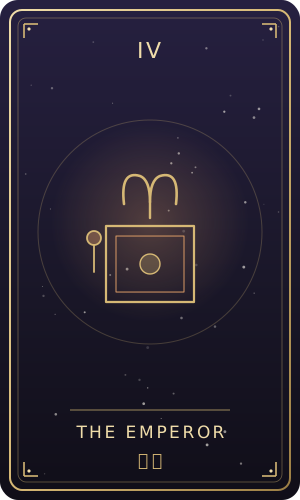
| The Emperor | A principled boss who likes to be in control | Be punctual, keep promises, build credibility through competence |
| The Hierophant | A senior colleague or culture built on tradition and procedure | Learn the rules first, then suggest improvements |
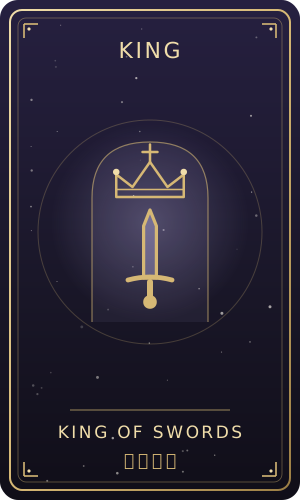
| King of Swords | A logical, exacting manager or advisor | Come organized, with data and evidence |
| Knight of Swords | A fast-moving, blunt, sometimes impatient coworker | Don't react to the tone; focus on the substance |
| Queen of Wands | A confident, charismatic person who lifts the room | Great partner for pitches; let them use their influence |
| Queen of Cups | A caring coworker and good listener | A real ally, but don't let them absorb everyone's stress |
| King of Pentacles | A steady, practical boss focused on results | Let reliable work and concrete numbers speak |
Reversed, the same trait may be overdone. The Emperor reversed can point to a controlling manager or rigid rules; the King of Swords reversed may describe someone using logic to shut down discussion. Remember, too, that a card describes an energy, not necessarily a specific person. Sometimes it's describing you.
Cards of Good Teamwork
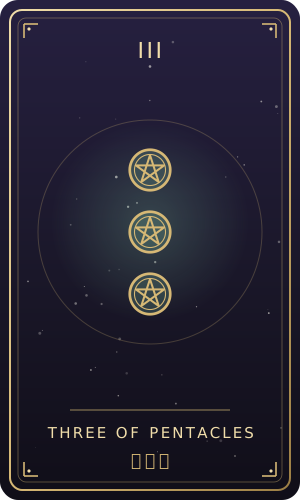
- Three of Pentacles: strong collaboration where everyone's skills count and your expertise is visible. Reversed, roles may be muddled and you may be doing the most while being noticed the least. Document your contributions and suggest clearer ownership.
- Temperance: you're the one who helps different personalities work together. Reversed, watch whether you're wearing yourself out trying to keep every group happy.
- Six of Pentacles: credit and resources are shared fairly and people help each other. Reversed, it flags imbalance, such as always cleaning up after others with nothing coming back.
Cards That Call for Caution: Conflict, Rumors and Hidden Agendas
Five of Swords: Winning at Any Cost
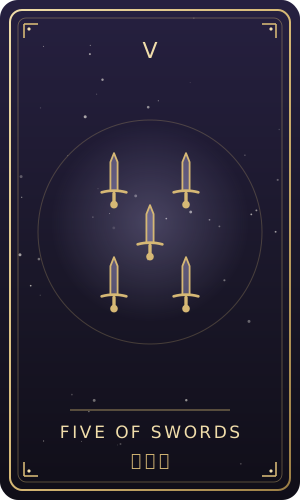
One figure gathers the swords while two others walk away defeated. The upright Five of Swords can point to power struggles, credit-grabbing or office politics. Rather than fighting every battle, decide which ones truly matter. Reversed, conflict is cooling and repair is possible, though it's wise to check that the other person genuinely wants peace.
Seven of Swords: Information Kept Quiet
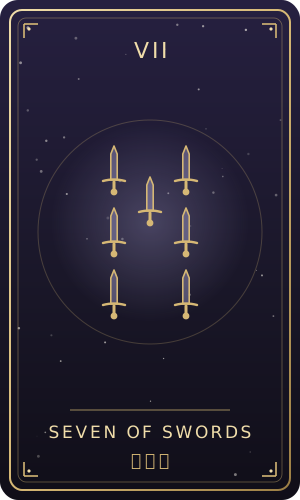
A figure sneaks off with an armful of swords. The upright Seven of Swords warns that someone may be acting behind the scenes, information may be withheld, or your work may be quietly claimed. Keeping records protects you better than a confrontation. Alongside The Devil, see the Devil and Seven of Swords combination, a reminder to stay clear of gray areas and hold onto your integrity. Reversed, hidden issues tend to surface and accountability becomes clearer.
The Moon: Rumors and Misunderstandings
A path disappears into moonlit haze. Upright, The Moon suggests rumors, undercurrents or opaque decisions that leave you uneasy. Don't rush to take sides; gather facts and keep doing your job well. Reversed, the fog is lifting and you're starting to see what actually happened.
Five of Wands: Friction Isn't Always Bad
Five figures swing staffs in what looks like a brawl but reads more like a heated brainstorm. This card can mean pitch competitions, a race for promotion or tension between departments. As long as debates stay about the work and not the person, the pressure can bring out your best.
Four Things to Do After a "Watch Out" Card
- Keep a paper trail. Confirm key decisions in writing and send a short recap after meetings.
- Address the issue, not the person. Keep responses focused on the work, not on anyone's character.
- Set boundaries. Skip the gossip, don't pass on unverified stories and don't overshare.
- Talk to someone you trust. A mentor, a senior colleague or a manager you respect can offer an outside view.
If people problems are making you dread every workday, read Should I quit my job? to sort out whether it's the people or the job you really want to leave.
Harassment and Bullying Need More Than Tarot
Workplace bullying, sexual harassment, threats or ongoing unfair treatment go beyond ordinary friction, and they're not something to hand over to the cards to decide whether it "counts" or whether to report it. Keep evidence such as messages, emails, dates and what happened, and raise it with HR or your company's formal complaint channel. You can also contact your local labor authority or an employment rights organization; in Taiwan, the Ministry of Labor's 1955 hotline is free and available around the clock. If your health is affected, please reach out to a doctor or counselor as well.
Try It on ORAE
To look at the dynamic between you and a specific coworker or boss, use the Friendship reading. It opens with the seven-card Two-Person Connection spread, which works just as well for work relationships: it moves from your thoughts and feelings to the other person's likely thoughts and feelings and your shared challenge, helping you see things from both sides. Keep in mind that the other person's cards show possibilities, not mind reading. For a wider view of your work life, try the Career Development spread.
ORAE is completely free with no sign-up required. Every draw uses a cryptographically secure shuffle, and interpretations follow fixed, transparent rules with no AI, at Basic, Deep or Expert depth. Tarot is a way to think through workplace tension, not a final verdict on anyone.
FAQ
Can tarot tell me who is working against me at the office?
We would not use it that way. The cards cannot reliably point to a specific person, and suspicion can damage good working relationships. Ask instead where things are stuck with a certain coworker, or how you can protect your work.
Does the Seven of Swords in a work reading mean someone is scheming?
It flags hidden information or someone acting behind the scenes, but it is not proof, and it can also describe your own habit of handling everything alone. The practical response is to keep records and confirm important things in writing.
Which tarot spread works for problems with my boss?
A two-person spread can show your thoughts and feelings, how your boss likely sees things and the challenge between you. For your overall work situation, try a career development spread. Follow up with a real conversation about expectations.
Do court cards always represent another person?
Not always. A court card might describe someone around you, a quality you are showing in the situation, or simply an approach to the problem. Use the context of your question to decide which reading fits best.
Should I use tarot to decide whether to report harassment?
No. Keep evidence and contact HR, your company complaint channel or a labor rights resource, and seek professional support if your health is affected. Tarot can help you process feelings, but it should never replace those protections.
Try a reading on ORAE
Free, no sign-up, no AI: fixed, transparent interpretation rules.