Free Online Tarot: Your First Reading, Step by Step
· 6 min read
New to free online tarot? This walkthrough follows ORAE's real reading screen: choosing a theme, writing a question, picking a spread and drawing method, reading results at three depths, and saving, sharing and taking notes, with a short worked example.
The first time you open a free online tarot site, the screen can feel like a cockpit. Which theme do you pick? How should you word the question? Which of all those spreads is for beginners, and what is the difference between the drawing methods? This guide walks through a free online tarot reading on ORAE exactly as the screen presents it, from getting ready to reading the result, and finishes with a short worked example. Feel free to open the reading page in another tab and follow along.
Before You Start: What a Free Online Tarot Reading Needs
ORAE is free, and you can read without an account. Interpretations don't come from AI: they are built from card meanings written by people and combined by fixed, transparent rules. All you need to bring is:
- Five to ten quiet minutes. A commute works, but try not to answer messages halfway through.
- Something you genuinely care about. It doesn't have to be big; "how to pace this week at work" is a fine topic.
- Somewhere to take notes. A phone note or a notebook makes it easy to look back later.
If you'd like a warm-up, draw one card first to get a feel for flipping cards, then come back for a full reading.
Step 1: Choose a Theme and Write Your Question
Choose a theme
The first block on the reading page is "Choose a theme", with six options: General Reading, Love Reading, Career Reading, Money Reading, Relationships and Self-Growth. The theme decides which part of each card's meaning the reading draws on, so the same card reads differently under Love than under Career.
Not sure? Leave it on General Reading and type your question. The site looks for keywords in your question, switches to the matching theme and shows "Recommended spreads" with a reason for each. This is ordinary rule-based code, not AI, and you can change the theme back at any time.
Write a clear question
The second block is "Your question". The hint underneath says that the more specific the question, the clearer the reading, and that you can leave it blank for general guidance. Your question is private by default; only you can see it.
A simple trick is to swap "will it happen?" for "what can I do?":
| Vague | More useful |
|---|---|
| Is my career luck good? | What should I focus on at work over the next three months? |
| Will they come back? | How can I handle where this relationship stands right now? |
| Will I succeed? | What are the strengths and obstacles in this plan? |
Open questions give every card room to say something. There's more on this in how to ask tarot questions.
Step 2: Pick a Beginner-Friendly Spread
The third block is the spread. When the site has suggestions, they appear first with their reasons, such as "Your question contains two options" or "Shows how things develop". Open "All spreads" to see the Basic spreads and Advanced spreads, 20 in total, each labelled with its number of cards and difficulty.
For a first reading, start with one of these:
- Single Card: one question, one card, the quickest way to the point.
- Two Cards: one card for the situation, one for advice.
- Past · Present · Future: the classic three-card spread and the default for a General Reading. Our three-card tarot guide covers it and five variations.
You can preview every spread's positions in the spreads library. Later on, the Professional Custom Spread lets you set 1–12 cards and name each position yourself.
Step 3: Drawing Method, Reversals and Depth
Under the spread you'll find the reading options.
Drawing method
| Method | What the screen says | Good for |
|---|---|---|
| Auto shuffle & deal | The deck is shuffled and dealt in order, the quickest way | Getting a result fast |
| Pick by hand | Choose your cards by intuition from 78 face-down cards | Enjoying the ritual of choosing |
| Interactive cut | After shuffling, you decide where to cut, then the cards are dealt | People used to cutting a physical deck |
All three give exactly the same odds. The deck is shuffled with cryptographic randomness before you choose and is never shown, so every card has the same chance whichever method you use. Pick the one that feels right. If you're curious about the mechanics, read how an online tarot draw works.
Reversals
Choose "Include reversed (50% each)" or "Upright only". If reversals are new to you, upright only is perfectly fine for a first reading; upright and reversed cards explains what reversals add.
Reading depth
Basic, Deep or Expert, with Deep as the default. This only sets which depth the result page opens on. You can switch on the result page at any time, so don't agonize over it here.
Step 4: Shuffle, Choose and Flip
Press "Shuffle the deck". You'll see "Shuffling…" and a prompt to breathe deeply and hold your question in mind. "Skip animation" jumps ahead if you'd rather not wait.
- Pick by hand: choose as many cards as the spread needs, then press "Done".
- Interactive cut: tap where you want to cut, then press "Cut here".
- Auto shuffle & deal: the cards are dealt as soon as the shuffle ends.
Then tap each card to flip it, or use "Reveal all". Once every card is face up, press "Read the full interpretation". The small "Random seed hash" line under the cards is verification data for this draw; you can ignore it and the reading works the same.
If your connection drops or you refresh by accident, you'll see a message that an unfinished reading was found and your original draw restored. Nothing gets redrawn.
Reading Your Online Tarot Result at Each Depth
The result page opens with your question, the time, the spread, the theme, the drawing method and a count of Major Arcana and reversed cards. The layout comes next, then the interpretation:
| Depth | What you get |
|---|---|
| Basic | Summary, each card's keywords and core meaning, strengths and obstacles, one action step, conclusion |
| Deep | Adds the full meaning, the theme reading, position analysis and advice for each card, card combinations and possible development |
| Expert | Adds each card's element, astrology, number, timing and imagery, an elements and suits analysis, the Major Arcana ratio and three layers of advice |
A good order: read the overall energy and summary for the big picture, go card by card, then finish with the action steps. On a first reading, skim Basic and then switch to Deep for detail. Expert suits people who already know the meanings and want to look at elements and numbers.
A Worked Example: One Three-Card Reading
Example: this person and these cards are invented for teaching. Lena wants to study Japanese after work, but her past attempts fizzled out within weeks. She picks Self-Growth and asks, "What do I most need to keep in mind while learning Japanese over the next three months?" She chooses Situation · Action · Outcome, picks by hand, includes reversals and reads at Deep.
| Position | Card | Orientation |
|---|---|---|
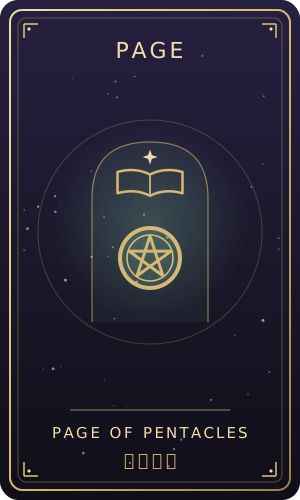
| Situation | Page of Pentacles | Upright |
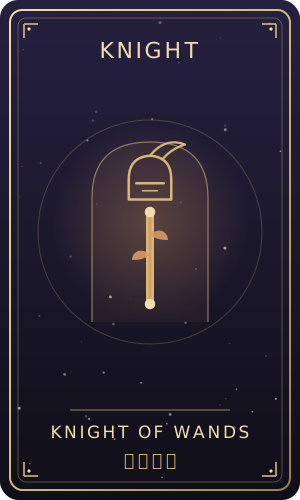
| Action | Knight of Wands | Reversed |
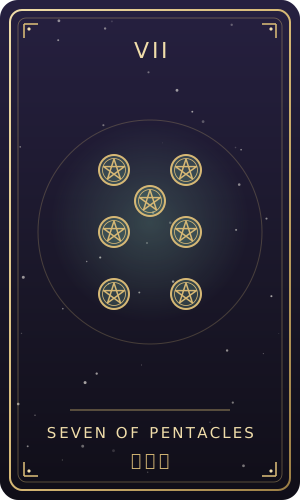
| Outcome | Seven of Pentacles | Upright |
Basic gives the gist. The Page of Pentacles upright is learning something new with real dedication, step by step. The Knight of Wands reversed is drive that has lost direction and turned into impatience or abandoned plans. The Seven of Pentacles upright is long-term effort: pausing to assess and giving growth the time it needs.
Deep adds the positions. A reversed Knight in the Action position doesn't say "don't act". It warns against charging in too hard: buying every textbook, studying three hours a night and burning out in a fortnight, which is exactly her old pattern. The Page's advice is to create a concrete study plan; the Seven reminds her that results take time.
In one sentence: "I'm ready to learn; this time I'll skip the sprint, build in small steady steps and check my progress at the three-month mark." In practice: twenty minutes a day, a weekly progress check and a small self-test at the end of month three.
The outcome card isn't a promise that she'll be fluent. It shows where things are likely to go if she keeps on this path.
Saving, Sharing and Notes
- Guests see everything. If you're not logged in, the result page notes that you're reading as a guest. Sign up and that reading is saved to your account too, so it appears in your History.
- My notes. Below the reading you can write how you feel or what happened later, then press "Save note". Reviewing notes a few weeks on is one of the best ways to learn; see how to keep a tarot journal.
- Favorite and journal. Members can press "Favorite" or "Add to journal" to link the reading to a journal entry.
- Share. "Share" lets you create a share link or download an image. "Include my question" is unticked by default, so friends see only the cards and summary. Your notes and personal details are never shared, and "Stop sharing" turns the link off.
- Other options. "Print / Save as PDF" gives you a paper copy, and "Delete" removes the reading.
A Few Tips for Your First Reading
- Don't keep redrawing the same question. Each reading is drawn once, and refreshing brings back the same cards. When something has genuinely changed, start a new reading.
- Treat the result as a prompt. Tarot helps you sort your thoughts; it doesn't guarantee the future. Is tarot accurate? covers why. For health, legal or financial decisions, rely on qualified professionals.
- Start small. Practise with one or three cards before you take on a ten-card spread like the Celtic Cross.
When you're ready, start your first online tarot reading.
FAQ
Do I need an account for a free online tarot reading?
No. On ORAE you can read and see the full interpretation without signing up. An account simply saves your readings to your History and lets you use favorites and a tarot journal.
Is the reading really free, or will I hit a paywall?
ORAE is free with no paid tiers, credits or locked sections. You can switch between all three reading depths at no cost; see how ORAE stays free.
Which drawing method is most accurate?
They're identical in terms of odds. The deck is shuffled with cryptographic randomness before you choose and is never revealed, so every card has the same chance. Pick whichever method feels most natural to you.
Which spread should a beginner start with?
Single Card, Two Cards or Past · Present · Future. With fewer cards it is easier to understand each one and to link them into a single clear sentence.
What if I chose the wrong reading depth?
It doesn't matter. The depth you pick before drawing is only where the result page opens. You can switch between Basic, Deep and Expert there at any time, and the cards stay the same.
Try a reading on ORAE
Free, no sign-up, no AI: fixed, transparent interpretation rules.