Three-Card Tarot: Past, Present, Future and Six Variations
· 6 min read
Three cards are the easiest spread to learn and one you never outgrow. Learn to read three cards together in five steps, explore six classic variations and follow a full worked example with real card meanings.
The three-card spread is where many people start with tarot, and it's one they keep coming back to for years. It's quick enough to draw in three minutes, yet complete enough to tell a story with a beginning, a turn and a direction. This guide covers how to read three cards together, six common variations and a full worked example. When you're done, try a free online tarot reading: the default spread for a General Reading is Past · Present · Future.
Why Three Cards Is the Best Place to Start
One card is a single reminder; ten cards are a report. Three cards are a short story, and that gives them a few advantages:
- Few cards. You have time to read each one properly without drowning in information.
- Clear relationships. Three cards form only three pairs, so it's easy to see how they echo or clash.
- Endless uses. Rename the three positions and the same spread answers a completely different question.
For the basics of positions and choosing spreads, start with the spread guide.
How to Read a Three-Card Tarot Spread in Five Steps
Whatever three-card layout you use, this order works:
- Look at the whole. Spend ten seconds on suits, Major Arcana and reversals. Three cards of one suit focus the theme: Cups lean towards feelings, Wands towards action, Swords towards thought and Pentacles towards practical matters. A Major Arcana card often marks a bigger turning point or inner lesson. Several reversals can point to something blocked, delayed or turned inward. The four suits explains more.
- Read each card in its position. Read the meaning, then ask what it means in this position. The same card says very different things as "past" and as "advice".
- Compare the pairs. How does card one become card two? Where does card two lead? Do the first and third cards echo or contrast?
- Focus on the middle card. In most three-card spreads the middle position is "present", "action" or "obstacle", which is usually where you have the most influence.
- Sum it up in one sentence, then pick one action. Try this template: "Because of ___ (card one), right now ___ (card two); if ___, things may move towards ___ (card three)."
Six Three-Card Variations
Here's the overview before we go through each one:
| Spread | Positions | Good for | On ORAE |
|---|---|---|---|
| Past · Present · Future | Past, present, future | How things developed and where they're heading | Built-in spread |
| Situation · Action · Outcome | Situation, action, outcome | Knowing what to do | Built-in spread |
| Mind · Body · Spirit | Body, mind, spirit | A personal check-in | Professional Custom Spread |
| You · Them · Relationship | You, them, the connection | Dynamics between two people | Professional Custom Spread |
| Option A · Option B · Advice | A, B, advice | Choosing between two paths | Professional Custom Spread |
| Strength · Obstacle · Advice | Strength, obstacle, advice | Assessing a plan | Built-in Strengths & Obstacles |
1. Past · Present · Future
The classic timeline. The past card explains why, the present card names what matters now, and the future card shows where things may go if nothing changes. A sample question: "Why has my friendship ended up where it is, and where is it heading?" Remember that the future card is current momentum, not a verdict. The worked example below uses this spread.
2. Situation · Action · Outcome
Situation · Action · Outcome focuses on what to do. A sample question: "How can I move this stalled project forward?" If the Four of Swords appears upright in the action position, the advice may be to rest and regroup rather than push harder. If the outcome card looks difficult, revisit the action card and adjust your approach.
3. Mind · Body · Spirit
The positions are body (routine, energy and physical signals), mind (thoughts and feelings) and spirit (inner longing and sense of meaning). ORAE has no built-in version, so use the Professional Custom Spread: set three cards and name the positions Body, Mind and Spirit. An upright Ten of Wands in the body position says you're carrying too much and asks which burdens are really yours. If you feel unwell, see a doctor first; the cards are only for reflecting on your rhythms. For more depth, try the nine-card Deep Self-Exploration.
4. You · Them · Relationship
The positions are your state, the other person's state and the connection between you. Set it up as a custom spread, or switch to the seven-card Two-Person Connection, which separates each person's thoughts and feelings. An upright Two of Cups in the relationship position shows two people who truly see each other. Keep in mind that the "them" card is your reading of how they might be, not mind-reading, so treat it as a starting point for a conversation.
5. Option A · Option B · Advice
Before drawing, write down exactly what A and B are: "A: stay at my current company; B: accept the new offer." Then compare the experience each card describes rather than hunting for the "good" one. An upright Justice in the advice position asks you to lay both options out honestly and rationally, then take responsibility for your choice. For more detail, the six-card A/B Choice shows the path and outcome of each option.
6. Strength · Obstacle · Advice
ORAE's built-in Strengths & Obstacles uses this structure, which is ideal before an interview, a pitch or a new project. A sample question: "What are my strengths and blind spots going into this job interview?" Note that a positive card can land in the obstacle position. An upright Sun there may warn of over-optimism, or of leaning too hard on one apparent advantage.
A Worked Example: A Friendship Told in Three Cups
Example: this person and these cards are invented for teaching. Hannah and her closest friend from university have drifted apart over the past two years. She chooses Relationships and asks, "Where is this friendship heading?" She uses Past · Present · Future with reversals included.
| Position | Card | Orientation |
|---|---|---|
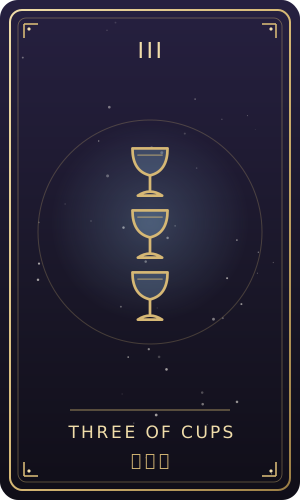
| Past | Three of Cups | Upright |
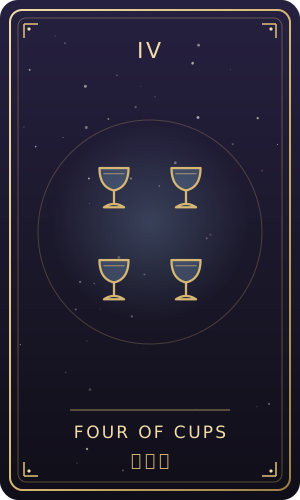
| Present | Four of Cups | Upright |
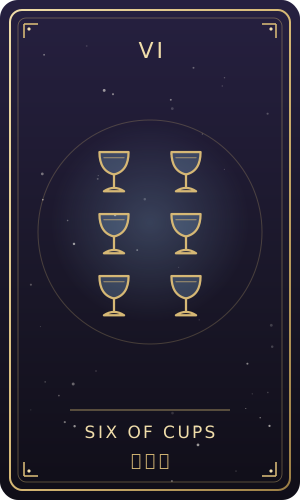
| Future | Six of Cups | Reversed |
The whole picture
All three cards are Cups, so the heart of the matter is feeling and connection, not who is to blame. With no Major Arcana, this is an everyday lesson rather than a life-changing turn. The only reversal sits in the future position, so it deserves a closer look.
Card by card
- Past: Three of Cups, upright. Three women raise their cups and dance: friendship, celebration and mutual support. The joy they shared was real, and so is the foundation of the friendship.
- Present: Four of Cups, upright. A young man sits under a tree with his arms crossed, not noticing the fourth cup offered from a cloud: apathy, withdrawal, missed openings. Interestingly, Hannah asked why her friend has gone quiet, but this card may be describing her: unenthusiastic about invitations, or feeling her friend doesn't really get her any more.
- Future: Six of Cups, reversed. Upright, this card is nostalgia and innocent kindness; reversed, it's being stuck in the past and romanticizing what was. On the current path, the friendship may stay a fond memory of university days.
Comparing the pairs
- Past to present: from celebrating together to not having the energy. That doesn't necessarily mean less affection; their lives may simply be in different phases.
- Present to future: the man in the Four of Cups ignores the cup held out to him, while the Six of Cups shows a boy handing a flower-filled cup to a girl, and reversed, that kindness is stuck in memory. Both cards are about not accepting the warmth on offer now.
- Past and future: both cards concern old times. The difference is that the Three of Cups is a celebration happening in the moment, and the reversed Six of Cups is longing for one that's gone.
One sentence and two actions
"You really were close. What has stalled things may be your own tiredness as much as the distance, and if you only look back, the friendship will stay a memory."
In practice:
- Following the Four of Cups' advice, look up and notice the kindness you've overlooked. Scroll back through your messages: did your friend reach out recently?
- Following the reversed Six of Cups, keep the memories worth keeping and let go of patterns that no longer fit. You don't need to recreate seeing each other daily; a monthly video call or lunch fits life as it is now.
The future card isn't a verdict. If Hannah reaches out first, the story can still change.
Common Three-Card Sticking Points
- All three reversed. Don't panic. Reversals often mean blocked, delayed or inward energy; find where things are stuck. See upright and reversed cards.
- Cards that seem to contradict each other. The contradiction is the message. A bright present card followed by a challenging future card may be telling you not to coast.
- Court cards. They can be a person or an attitude; read them first as an attitude you need. More in court cards.
- A frightening future card. Cards like The Tower and Death are widely misunderstood; read the scariest tarot cards and what they really mean, and remember the future card is a trend.
- Wanting a fourth card. That's fine, but finish reading the three first. Redrawing the same question over and over usually becomes a search for the answer you want.
Drawing Three Cards on ORAE
- Built-in spreads: start a free online tarot reading. With the General theme the default is Past · Present · Future, and under "All spreads" you'll also find Situation · Action · Outcome, Strengths & Obstacles and the morning-friendly Daily Direction.
- Your own three cards: choose the Professional Custom Spread, set the number of cards to 3 and type one position name per line, such as Body, Mind and Spirit.
- Any drawing method: Auto shuffle & deal, Pick by hand and Interactive cut all give identical odds, so choose the one you enjoy.
ORAE is free, needs no account and uses no AI. For a walkthrough of the whole process, see your first free online tarot reading. Once three cards feel natural, a ten-card Celtic Cross won't seem so daunting.
FAQ
Which card should I read first in a three-card spread?
Take a few seconds to scan suits, Major Arcana and reversals, then read each card in position order, compare the pairs and sum up all three in one sentence. In most three-card spreads the middle card deserves the most attention.
Is the "future" card in Past · Present · Future accurate?
The future card shows where things may go if the current direction continues. It is not a fixed ending. If your thinking and actions change, the direction can change too, so use it to adjust what you are doing now.
Which three-card spreads does ORAE offer?
Built in: Past · Present · Future, Situation · Action · Outcome, Strengths & Obstacles and Daily Direction. For Mind · Body · Spirit, You · Them · Relationship or A · B · Advice, use the Professional Custom Spread with three cards and name the positions yourself.
All three of my cards came out reversed. Is that bad?
Not necessarily. Reversals often point to blocked, delayed or inward energy, so three reversals usually signal that something is stuck. Finding where it is stuck and how to loosen it helps more than calling the reading bad.
Can I do a three-card reading online for free?
Yes. On ORAE you can draw three cards free without an account, using auto-deal, picking by hand or an interactive cut, then read the result at Basic, Deep or Expert depth.
Try a reading on ORAE
Free, no sign-up, no AI: fixed, transparent interpretation rules.