Why Tarot Feels Spot On: The Maths of Coincidence
· 6 min read
Why do tarot readings feel so accurate? We calculate the real odds of drawing a specific card, repeats, friends matching, Major Arcana and the "scary" cards, then explain the Barnum effect, confirmation bias and why tarot is still useful.
You ask whether he still cares and turn over the Two of Cups. Your card of the day is The Hermit two days out of three. A friend draws at the same moment and gets exactly the same card as you. Moments like these make people say "that's uncanny." So why does tarot feel spot on so often? We cover the big question in Is Tarot Accurate? This post zooms in on something narrower: the actual odds behind those "how did it know?" moments. Every number below was calculated exactly with a script, assuming a fairly shuffled 78-card deck and a 50% chance of each card landing reversed.
The Basic Odds: How Hard Is It to Draw a Specific Card?
Every card in a fair deck is equally likely. Draw one card and the chance it's a particular card, say Death, is 1 in 78. Specify upright as well and it halves to 1 in 156. In a multi-card spread the card counts as "appearing" in any position, so the chance is simply the number of cards divided by 78.
| Situation | Exact | Roughly |
|---|---|---|
| One card, a specific card | 1/78 | 1.28% |
| One card, a specific card upright | 1/156 | 0.64% |
| Three-card spread contains a specific card | 3/78 | 3.85% |
| Three-card spread contains it upright | 3/156 | 1.92% |
| Ten-card spread contains a specific card | 10/78 | 12.8% |
| Ten-card spread contains it upright | 10/156 | 6.41% |
On its own, drawing a named card really is unlikely. But most of the coincidences that make us gasp aren't about a card we named in advance. They're about noticing, afterwards, that some card fits. Those two kinds of event have wildly different odds.
Daily Draws: When Does a Repeat Become Likely?
Say you draw one card a day from a freshly shuffled deck. Intuition says that with 78 cards, repeats should take ages. This is the famous birthday problem: in a room of just 23 people, the chance that two of them share a birthday is already over 50%. For tarot:
- After 10 daily draws, the chance that at least one card has appeared twice is about 45.2%.
- By the 11th draw it passes half, at about 52.2%.
- Require the same card in the same orientation and it takes 15 draws to pass half, at about 50.1%.
Now flip it around. To have a better-than-even chance of meeting one particular card you have in mind, you need 54 draws (about 50.2%). A repeat of some card is likely within two weeks; the one card you're waiting for can take nearly two months. Repeats feel meaningful because we notice which card repeated after the fact. For more on recurring cards and how to work with them, see Why Do I Keep Drawing the Same Tarot Card?
Two Friends, Same Card: Fate or Arithmetic?
You and a friend each draw one card. The chance you get the same card is 1 in 78, about 1.28%, and the same card in the same orientation is 1 in 156, about 0.64%. That's rare enough to be fun to talk about.
Add more people, though, and the birthday problem kicks in again:
| People each drawing one card | Chance at least two match |
|---|---|
| 2 | 1.28% |
| 5 | 12.3% |
| 8 | 31.0% |
| 11 | 52.2% |
At a gathering of eleven, it's more likely than not that two people draw the same card. Enjoy the coincidence; it doesn't mean your fates are linked.
Lots of Major Arcana Means Something Big?
There are 22 Major Arcana cards out of 78, about 28%. In a ten-card Celtic Cross you should expect 22/78 × 10 ≈ 2.82 of them on average. The distribution looks like this:
- At least 3 Majors: about 57.8%, so more than half of all ten-card readings.
- At least 4 Majors: about 29.5%.
- No Majors at all: only about 2.8%.
In a three-card spread, at least one Major turns up about 63.6% of the time. So "three Majors means a life-changing event" deserves some skepticism. A high share of Majors can hint that a question touches deeper themes, but three of them in a Celtic Cross is the norm, not an omen.
How Often Do Death, The Tower and The Devil Show Up?
Death, The Tower and The Devil are often called the three scariest cards. Here is the chance of at least one of them appearing:
| Situation | Chance of at least one |
|---|---|
| One card | 3.85% |
| Three-card spread | 11.2% (roughly 1 reading in 9) |
| Ten-card spread | 34.1% |
| One card a day for 7 days | 24.0% |
| One card a day for 30 days | 69.2% |
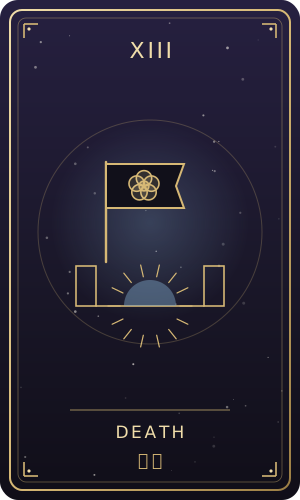
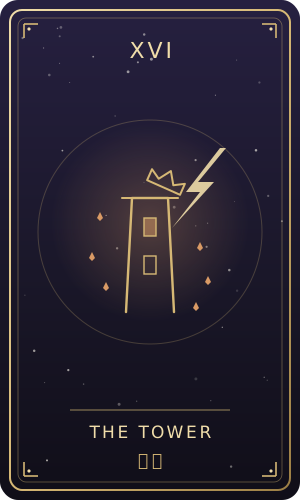
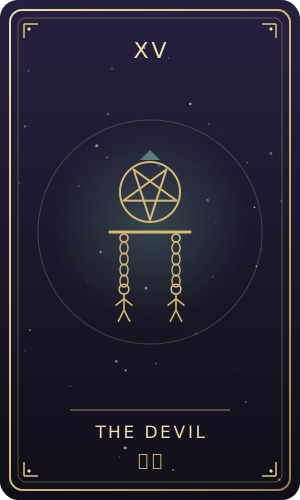
Anyone who draws regularly will meet these cards sooner or later. That's arithmetic, not bad luck. Their meanings are also gentler than their names: Death speaks of transformation and the close of a chapter, The Tower of a structure that was less solid than it looked giving way so the truth can surface, and The Devil of habits or attachments that hold you. Our guide to the scariest tarot cards goes deeper.
Why Tarot Feels Accurate: Four Psychological Effects
Probability shows how common coincidences are. Psychology explains why they move us so much.
The Barnum (Forer) effect
In a well-known classroom experiment in the late 1940s, psychologist Bertram Forer gave his students a personality test and then handed each of them a "personal" profile. Everyone received the same text, mostly sentences taken from an astrology book, yet most students rated it as a good description of themselves. This tendency to accept general statements as personal ones is called the Barnum effect, or the Forer effect.
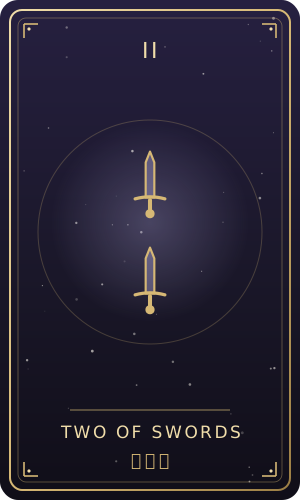
Card meanings have to cover many situations, so they're written broadly. The upright Two of Swords, for instance, describes someone caught between two options who, afraid of choosing wrongly, has decided not to look or move. How many people who sit down to ask tarot a question aren't stuck in front of some decision?
Confirmation bias
We notice and remember information that fits what we expect. If one line out of five in a reading lands, that's the line you'll remember; the other four quietly fade. And when things turn out differently, it's tempting to reinterpret the card until it fits.
A brain built to find meaning
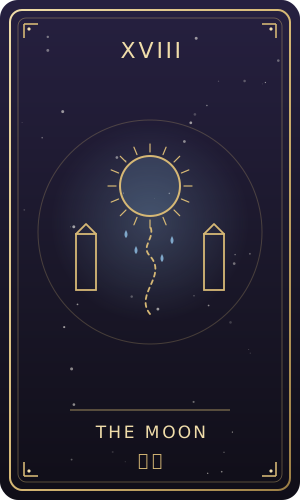
Our brains are excellent at spotting patterns in random events. It's how we learn from experience, and it's also why coincidences feel like messages. As The Moon warns, it's easy to mistake a guess for a fact. One example: the chance of at least one Cups card in a three-card spread is about 45.2%. Draw a Cup while asking about love and it feels as if the deck understands you, yet nearly half of all three-card spreads contain a Cup whatever you ask.
The hits get shared
Huge numbers of people draw cards every day. The startlingly accurate reading gets screenshotted, posted and remembered; the many ordinary ones rarely get mentioned. The "so accurate!" stories we hear are already a filtered sample.
One Card, Three People, Three "Hits"
Here's an invented example to make the point. Three people draw the upright Two of Swords on the same day:
- Lee asks about work: "Should I accept an overseas posting?" It fits, he says, because he hasn't dared raise it with his family.
- Fang asks about love: "Should I say something about this flirtation?" It fits for her too; she has been pretending it's nothing.
- Joe asks about moving: "Should I move across town or stay put?" Also a hit: he hasn't viewed a single flat in either place.
Three different lives, each recognized in the same paragraph. That doesn't make the card useless. Its advice, to take off the blindfold and honestly write down what you care about, is practical for all three. It just shows how much of a reading's power comes from the person asking.
So Is Tarot Still Worth Using?
Yes, and understanding the odds helps you use it better:
- Treat randomness as a fresh angle. A card you didn't expect forces you to look at the question from another side. That's where tarot shines.
- Read the card as a question, not an answer. "If this card were a reminder, what would it be reminding me of?" beats "What does this card predict?"
- Write it down and compare later. Recording each reading and what followed shows you which hits were coincidence and which perspectives genuinely helped. Our tarot journal guide explains how.
- Use real information for big decisions. For health, legal, financial and investment matters, rely on qualified professionals. Tarot can help you sort your thoughts; it can't replace advice.
How ORAE Keeps These Odds Honest
All of the numbers above assume every card is equally likely. On ORAE, each reading starts with a random seed from the operating system's cryptographically secure random number generator, and that seed shuffles all 78 cards. Before you draw, the screen shows only a hash of the seed; afterwards the seed itself is revealed so the result can be recomputed. Whether you choose Auto shuffle & deal, Pick by hand or Interactive cut, every card has the same chance, and the question you type never influences which cards appear. For the details, read How an Online Tarot Draw Works.
To feel the gap between chance and meaning for yourself, draw one card. Before asking whether it's accurate, ask: "What's the first thing this card makes me think of?" The answer is usually what you actually care about.
FAQ
Why does tarot feel so accurate?
Usually several things combine: coincidences are more common than intuition suggests, card meanings are broad enough to fit many lives (the Barnum effect), and we remember the hits more than the misses (confirmation bias). Feeling accurate isn't the same as predicting the future; see Is Tarot Accurate? for the bigger picture.
What are the odds of drawing a specific tarot card?
From a fairly shuffled 78-card deck, one draw gives a specific card 1 time in 78, about 1.28%, and that card upright 1 in 156, about 0.64%. It appears in a three-card spread about 3.85% of the time and in a ten-card spread about 12.8%.
If I draw one card a day, how soon will a card repeat?
By the 11th draw, the chance that at least one card has appeared twice passes 50% (about 52.2%). Waiting for one particular card is much slower: it takes 54 draws before the odds of seeing it pass 50%.
Does a reading full of Major Arcana mean something serious?
Not necessarily. A ten-card spread contains about 2.82 Majors on average, and at least three turn up about 57.8% of the time. A high share can hint at deeper themes, but three Majors is normal rather than an omen.
Is drawing Death, The Tower or The Devil a bad sign?
No. At least one of them appears in about 11.2% of three-card spreads, and over 30 days of one-card daily draws the chance rises to about 69.2%. They speak of transformation, revelation and noticing what holds you; see the scariest tarot cards.
Try a reading on ORAE
Free, no sign-up, no AI: fixed, transparent interpretation rules.