Stuck Mid-Reading? Six Ways to Link Tarot Cards Into a Story
· 6 min read
You know every card, yet a spread still comes out as a list of definitions. These six techniques, from position roles to finding the key card, plus a worked three-card example, show how to read cards together.
After a while with tarot, many learners hit the same wall. They can look up every card, but when the cards are laid out in a spread, the reading comes out as a list of definitions instead of a story. This lesson gives you six practical techniques for seeing how cards relate, then works through a three-card example from "reading the dictionary" to telling a story.
Why You Get Stuck, and Six Techniques at a Glance
We get stuck because we keep asking "What does this card mean?" and forget to ask "What is this card saying, in this position, about this question, and how does it relate to its neighbors?" Single meanings live in the card library, and the basic ideas behind combinations (reinforcing, modifying and creating tension) are covered in Reading Card Combinations. This page is about the hands-on work of linking:
| Technique | What you look at | What it answers |
|---|---|---|
| 1 Position roles | The question each position asks | What is this card answering? |
| 2 Gaze and direction | Where figures look or walk | Where is the energy flowing? |
| 3 Suits and elements | What dominates, what's missing, what's adjacent | What's the main theme? |
| 4 Number progressions | Sequences, repeats, jumps | What stage has this reached? |
| 5 Pairing | Two cards read together | How do cards explain each other? |
| 6 The key card | The heaviest card | Who is the story about? |
1. Read the Position's Role Before the Card
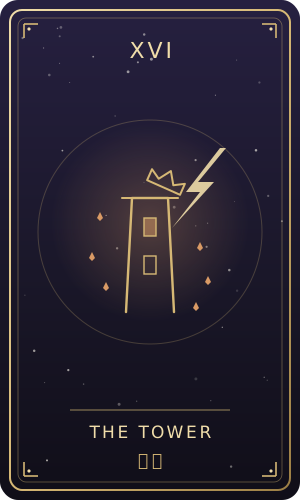
The same card answers a different question in each position. Before reading, turn every position into a question: Challenge becomes "What's blocking me?", Advice becomes "What can I do?" Here is The Tower, upright:
| Position | The question | The Tower here |
|---|---|---|
| Past | What shaped this? | An upheaval that already happened and set today's situation in motion |
| Challenge | What's blocking me? | Security built on an unstable foundation, so any jolt knocks you off balance |
| Advice | What can I do? | Accept that something no longer holds; steady yourself and rebuild from what's real |
| Outcome | Where is this heading? | A sudden turn or revelation that clears room to rebuild on something truer |
The Tower isn't simply "bad things happen." The position decides what angle it speaks from. To practice, place one card in three or four positions and write a sentence for each; the feel for it comes quickly.
2. Follow the Gaze and Direction
Rider-Waite-Smith images move. Figures look down, look back or walk away, and treating the gaze as the direction of energy often reveals the plot:
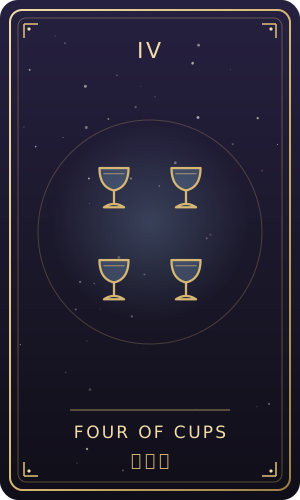
- Four of Cups: staring at three cups and ignoring the fourth offered from a cloud. An opportunity is right there, unseen.
- Seven of Swords: sneaking off with an armful of swords while glancing back. The mind is still behind him, out of guilt or attachment.
- Eight of Cups: turning away toward distant hills and leaving neat rows of cups behind. A deliberate departure.
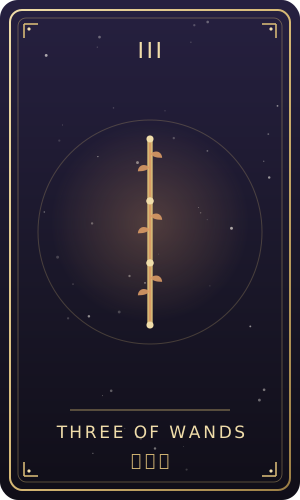
- Three of Wands: back turned to us, watching ships at sea. The focus is already on the future.
In a spread, two court figures facing each other can suggest mutual attention, while figures back to back may be looking in different directions. You can also notice which card a figure faces. Looking toward the outcome can read as anticipation; turning away from the advice card might suggest avoiding it. Directions differ between decks, so go by the deck in front of you and treat this as a hint, not a rule.
3. Find the Theme in Suits and Elements
Count the suits first (see The Four Suits):
- What dominates. Three Swords in five cards suggests the issue sits in thoughts, communication or conflict.
- What's missing. A career question with no Pentacles invites a check: have salary, time and budget actually been discussed?
- What's adjacent. In the Golden Dawn system, Fire and Air support each other, as do Water and Earth, while Fire and Water, and Air and Earth, pull against each other (see The Four Elements). The Knight of Wands next to the Queen of Cups is fire meeting water: one wants to act now, the other needs to feel understood first, and that mismatch in pace is the story.
On ORAE, the Expert reading depth shows element counts and the elemental dignity between neighboring cards, which is a good check on your own observations.
4. Track Number Progressions
Numbers show how far a matter has developed (rules in Number Symbolism). Look for three kinds of clue:
- A same-suit sequence. The Three of Swords followed by the Four of Swords moves from heartache into rest. The Two of Cups followed by the Three of Cups takes a private bond out into a circle of friends.
- A repeated number. Several Fives together make change and challenge the theme.
- The size of a jump. An Ace of Wands in the past and the Ten of Wands in the present goes from spark to crushing load. Ask where the project started getting too heavy.
If there's no number clue, skip this step rather than forcing one.
5. Pair Cards So They Explain Each Other
Two cards read together are often clearer than either alone. A few classic pairs:
- The Tower + The Star: hope after the storm; the hardest part is over and healing has begun.
- The Moon + Nine of Swords: late-night worry magnified by imagination, with the story in your head scarier than reality.
- The Hermit + Eight of Cups: turning away to seek deeper meaning.
- Death + Five of Cups: grieving an ending well while noticing what remains.
- The Sun + Ten of Swords: the Ten of Swords looks alarming, but The Sun beside it says the lowest point has passed and dawn is coming. One card modifying another.
In a spread, the most useful pairs are usually Present with Outcome (where the story goes) and Challenge with Advice (how the block can ease). Browse more in Tarot Card Combinations.
6. Find the Key Card
Most spreads have one key card; the others explain why it appeared, how to reach it or how to move past it. Check in order: Is there a Major Arcana card? Which card sits in a core position such as Present, Action or Outcome? Which answers your question most directly? Which one does your eye keep returning to? Then state the key card's message in one sentence and attach the others to it. Pick only one; if everything is key, nothing is. In a Five Card Deep Dive where the only Major lands in Likely Outcome, that card is usually the key, and the other four explain how things get there.
Worked Example: From Stuck to Story in Three Cards
This is a fictional example for teaching, with meanings from the ORAE card database.
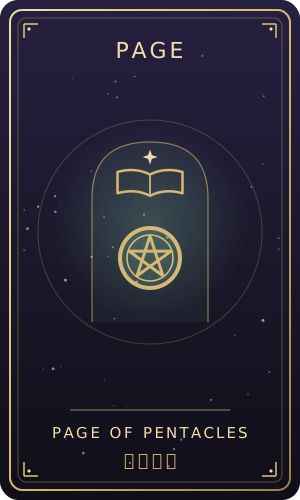
Example: Lena loves drawing and has wanted to start an illustration account for six months, but keeps putting it off. Her question: "Over the next month, how can I get my illustration account started?" Using Situation · Action · Outcome, she draws the Four of Cups, the Page of Pentacles and the Three of Wands, all upright.
The stuck version: "Four of Cups is apathy, Page of Pentacles is learning, Three of Wands is expansion." All true, and none of it answers her question. With the six techniques:
- Position roles. The Four of Cups is where she stands now, the Page is the recommended approach, and the Three of Wands is where that approach may lead.
- Gaze. The Four of Cups looks down and ignores the offered cup; the Page gazes intently at the coin in his hands; the Three of Wands looks out at distant ships. Down, then in hand, then far ahead: the eyes already tell the story.
- Suits and elements. One each of Water, Earth and Fire, and no Swords. She isn't short of ideas or plans; she has thought enough. Water and Earth sit side by side and support each other, so her feelings can be grounded by concrete steps.
- Numbers. Four, Page, Three: no sequence, so skip it.
- Pairing. The cup ignored in the Four of Cups becomes, in the next card, a coin the Page holds up and studies closely. The opportunity isn't far away; it's one small thing in her hands, looked at carefully.
- Key card. The Page of Pentacles, sitting in the Action position and linking the other two.
The story:
It isn't that you lack inspiration; you've lost interest in the chance in front of you and keep feeling something is missing (Four of Cups). Rather than waiting for enthusiasm to return, take one concrete thing in hand like the Page: one drawing a week, posted on a set day. Keep at it and you'll start to see ships on the horizon: a growing body of work, and new opportunities that may come with it (Three of Wands).
Note the word "may." The outcome is a possible development of steady action, not a promise of followers.
Check Your Story With Four Questions
- Did you use every card, or skip one you didn't like?
- Does the story come back to the original question?
- Is there one concrete action for this week?
- Did "might" quietly turn into "will"?
You won't need all six techniques every time; two or three strong clues are enough. For practice, try ten tarot practice exercises, walk through a full reading in seven steps, or ask your own question with a free online tarot reading. ORAE's Deep and Expert interpretations list the combinations and patterns in your spread, which makes a useful comparison once you've built your own story.
FAQ
How do I stop reading tarot like a list of definitions?
Turn each position into a question and let the card answer it. Then pick one key card and connect the others to it with "because," "so" and "therefore." Keep bringing every sentence back to the original question.
How do I find the key card in a spread?
Check whether there is a Major Arcana card, which card sits in a core position such as Present or Outcome, which answers the question most directly, and which one keeps drawing your eye. Choose just one and let the rest explain it.
What if a spread has no obvious combinations?
Not every spread has number or suit patterns, so skip them rather than forcing one. Position roles and the key card are usually the most helpful, and you can still pair Present with Outcome and Challenge with Advice.
Is the direction a figure faces a fixed rule?
No. It is a way of observing the image, and different decks draw figures differently. Go by the deck you are using, and let it add to the story rather than replace the card meaning and position.
Try a reading on ORAE
Free, no sign-up, no AI: fixed, transparent interpretation rules.