Ten Tarot Practice Exercises to Make Your Readings Stronger
· 6 min read
Reading more meanings only gets you so far. These ten tarot practice exercises, each with a goal, steps, time needed and a sample answer, build the skills that actually make readings better.
Reading more card meanings only takes you so far; readings get stronger when you practice. Here are ten tarot practice exercises for self-study, each with a goal, steps, time needed and a sample answer. The sample answers show one way of thinking, not the "right" answer. Meanings follow the ORAE card database, and the scenarios are fictional, made for teaching.
Before You Start: How to Use These Exercises
Grab a notebook or notes app and either a deck or ORAE's free tools, then pick one exercise:
| # | Exercise | Skill | Time |
|---|---|---|---|
| 1 | One card, three angles | Flexible meanings | 10 min |
| 2 | Image before meaning | Observation | 5–10 min |
| 3 | Same card, different positions | Position sense | 10 min |
| 4 | Reversed rewrites | Reasoning out reversals | 10 min |
| 5 | A card for a film or song scene | Association | 10 min |
| 6 | Reading for a fictional character | Synthesis and checking | 15 min |
| 7 | Court-card personality guess | Court cards | 10 min |
| 8 | Element balance check | Seeing the whole | 10 min |
| 9 | Timed three-card synthesis | Speed and focus | 3 + 10 min |
| 10 | Reviewing an old reading | Self-correction | 15 min |
If meanings still feel shaky, start with learning all 78 cards in four weeks.
The Basics: Going Deeper With One Card (1–4)
1. One Card, Three Angles
- Goal: let one card answer questions on different topics, not just repeat a keyword.
- Steps: draw one card with Draw One; write one sentence for love, one for work and one for personal growth; then compare with the card's topic pages.
- Time: 10 minutes.
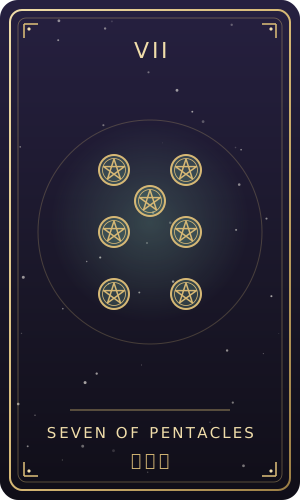
- Sample answer: Seven of Pentacles, upright. Love: "Steady, undramatic growth; a good time to talk about shared hopes." Work: "Long-term effort is adding up; review progress, then continue." Growth: "Respect the pace of change and credit the progress already made." Then check the Seven of Pentacles career meaning for anything you missed.
2. Image Before Meaning
- Goal: sharpen observation so the image becomes your first source.
- Steps: cover the name and meaning; describe in three sentences what the figure is doing, the setting and the mood; guess the meaning, then check.
- Time: 5–10 minutes.
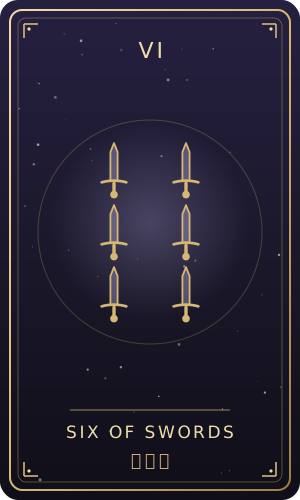
- Sample answer: Six of Swords. "A ferryman poles a small boat carrying a cloaked woman and a child, six swords upright at the bow. The water is choppy on one side and calmer ahead. It feels quiet and a bit weary." My guess: leaving difficulty for calmer ground while carrying memories. The listed meaning: transition, moving on, calmer waters.
3. Same Card, Different Positions
- Goal: feel how a position changes what a card says.
- Steps: pick a card and write one sentence each for Past, Obstacle, Advice and Outcome; then compare with the "In key spread positions" notes on the card's topic pages.
- Time: 10 minutes.
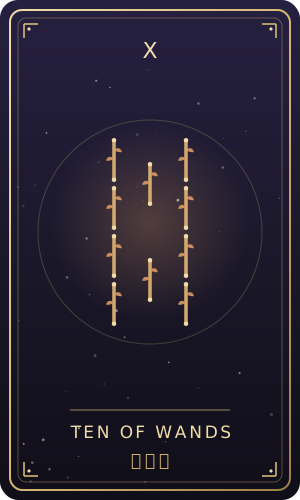
- Sample answer: Ten of Wands, upright. Past: "You've just come through a very heavy stretch." Obstacle: "Carrying everything alone blocks your view." Advice: "List your responsibilities, keep only what's truly yours, and practice delegating and saying no." Outcome: "You may reach the goal, but at a cost to your energy."
4. Reversed Rewrites
- Goal: reason out reversals instead of memorizing them.
- Steps: read the upright keywords, then write a reversed sentence using each of the four approaches in Upright and Reversed (blocked or delayed, turned inward, too much or too little, moving out of it), and compare with the listed reversed meaning.
- Time: 10 minutes.
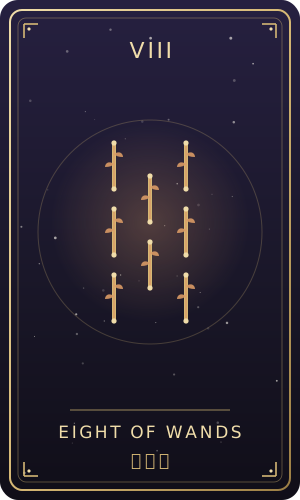
- Sample answer: The Eight of Wands upright is swift progress and incoming news. Blocked: "Things stall; the message doesn't arrive." Too much: "Rushing, losing rhythm." Turned inward: "Nothing moves outside, but you keep pushing yourself inside." Listed meaning: delays, obstacles, haste, miscommunication. The first two match; the third is your own extension to keep watching in your notes.
Association: Linking Cards to Stories and People (5–7)
5. A Card for a Film or Song Scene
- Goal: tie meanings to concrete scenes so you can give real examples in readings.
- Steps: choose a film moment or a song line you like and describe it in one sentence; pick one or two cards that fit, explain why, and consider a runner-up.
- Time: 10 minutes.
- Sample answer: Scene: "At dawn, the main character drags a suitcase out of the city she's lived in for ten years." Option one, the Eight of Cups: choosing to leave a life that no longer fulfills her. Option two, the Six of Swords: a transition from turmoil to calm. If she decided to let go, it's the Eight of Cups; if she's escaping hardship while still hurting, it's the Six of Swords.
6. Reading for a Fictional Character
- Goal: test whether your reading catches the heart of a story whose ending you already know.
- Steps: pick a character you know well and set a question at a point in their story; draw three cards in Situation · Action · Outcome, read them, then compare with what happens next.
- Time: 15 minutes.
- Sample answer: Cinderella, before the ball, asks: "How should I approach tonight?" Situation, Ten of Wands: crushed under endless chores. Action, The Magician: the tools you need are already at hand, so focus your will and act. Outcome, Wheel of Fortune: a turning point, and a reminder that timing matters. Fittingly, the story turns on a midnight deadline.
7. Court-Card Personality Guess
- Goal: read the 16 court cards as rounded people, not just ranks.
- Steps: write a short character description (fictional, or a blend of several people); choose a court card by rank plus suit, then note a runner-up and why you chose between them.
- Time: 10 minutes.
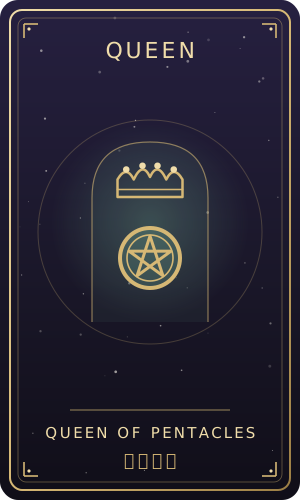
- Sample answer: "Always remembers birthdays, quietly brings snacks, puts the phone down to really listen." Candidates: the Queen of Cups and the Queen of Pentacles. If emotional attunement is the point, it's the Queen of Cups; this description is mostly practical care, so I'd pick the Queen of Pentacles. Keep this in your own notes rather than labeling real people. See The Court Cards for the basics.
Integration: Seeing the Whole, Fast (8–9)
8. Element Balance Check
- Goal: spot overall tendencies across many cards.
- Steps: list your last ten cards (for example ten days of your Daily Card); count each suit and the Majors; note the strongest and weakest elements and how they relate to your life lately.
- Time: 10 minutes.
- Sample answer: Swords 4, Cups 3, Wands 1, Pentacles 0, Majors 2. Air and Water dominate: lots of thinking and feeling, less action and practical care. Ask yourself whether sleep, exercise and money have been pushed aside. ORAE members can use Personal Insights, which shows suit distribution and Major Arcana ratio.
9. Timed Three-Card Synthesis
- Goal: find the main point under time pressure.
- Steps: draw three cards for Past · Present · Future; set a three-minute timer and write a single summary sentence; then spend ten minutes expanding it and see whether your first instinct caught the main line.
- Time: 3 + 10 minutes.
- Sample answer: Past Three of Swords, Present Four of Swords, Future Ace of Wands. One sentence: "After that heartbreak you're resting and recovering, and once your strength returns, a new passion will catch fire." Expanding it, notice the same-suit sequence from Three to Four, heartache to rest, and that Air and Fire are supportive elements.
Review: Learning From Old Readings (10)
10. Reviewing an Old Reading
- Goal: calibrate your reading habits against what actually happened, the most direct way to improve.
- Steps: pick a reading from two to four weeks ago and reread it; answer which card matched events best, what you missed and whether you acted on the advice; finish with one line on what to remember next time you see that card.
- Time: 15 minutes.
- Sample answer: Three weeks ago: "What should I watch for in this pitch?" The obstacle was the Five of Wands. I read it as "someone will push back." Looking back, the clash was inside our own team, with too many unmerged opinions. Next time, I'll first ask whether the conflict is out there or among us. For journaling and review rhythms, see How to Keep a Tarot Journal.
A Weekly Practice Plan
| Day | Exercise | Tool |
|---|---|---|
| Mon | 1 + 2 | Draw One |
| Tue | 3 | The 78-card library |
| Wed | 4 | Reversed meanings on card pages |
| Thu | 5 or 7 | Notebook |
| Fri | 9 | A three-card spread |
| Sat | 6 | Situation · Action · Outcome |
| Sun | 8 + 10 | Daily Card log and tarot journal |
After a week, repeat with new cards. Each exercise gets faster, and your notes start to sound like you.
Practicing on ORAE
Every exercise works with a physical deck, and ORAE's free tools help: Draw One suits exercises one to four, the tarot flashcards make a good warm-up, and the Daily Card gives you one fixed card a day to build up data for exercise eight. When signed in, readings are saved to your history with notes and journal entries for exercise ten. To apply all this to a full reading, follow a full reading in seven steps with your own question in a free online tarot reading, or read six ways to link cards into a story. And remember that practice makes you a clearer thinker and storyteller; tarot itself guarantees no outcome.
FAQ
How long should I practice tarot each day?
Ten to fifteen minutes a day is plenty; consistency matters most. Pick one exercise each day and save the element check and review for the weekend. That beats an occasional multi-hour session.
Should I look at card meanings while practicing?
Write your own answer first, then compare. Only then can you see where you match the listed meaning and where you are adding your own insight. Copying the meaning straight away weakens the exercise.
Are the sample answers the correct answers?
No. They show one line of reasoning, and the same card can support different reasonable readings. If you can point to your evidence, such as the image, suit, number or position, your answer is worth keeping.
Can I do these exercises without a physical deck?
Yes. Use ORAE's Draw One or Daily Card to draw, and the card pages for images and upright and reversed meanings. Drawing and looking up meanings are free and need no account.
Try a reading on ORAE
Free, no sign-up, no AI: fixed, transparent interpretation rules.